What is Google Meridian?
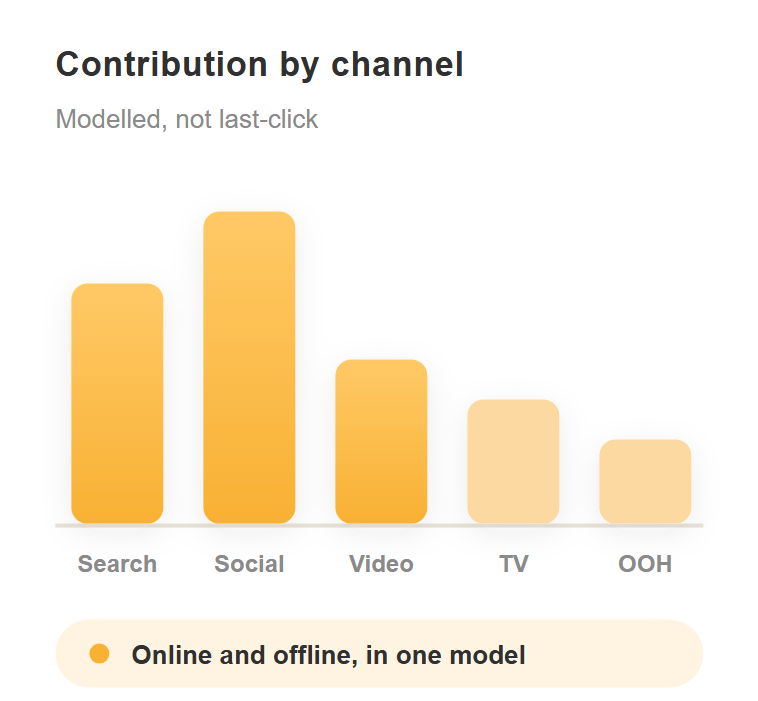
Meridian is Google’s open-source marketing mix model. It uses aggregated data to measure the impact of your marketing across channels and account for non-marketing factors that affect sales, so you can see what each channel actually contributed and plan where the next dollar goes.
How is it different from Google Ads or GA4 reporting?
Platform reports tell you what each channel claims credit for. Meridian looks at the whole mix and estimates what would have happened without each channel. It’s built on Bayesian causal inference and accounts for seasonality, pricing and promotions.
It has also moved on since launch. Google added a Scenario Planner in early 2026, a budget planning interface that lets marketers test different budget scenarios and see real-time ROI estimates with no coding required. More recently Google added AI assistance for building the model, extended it to upper-funnel channels like TV and out-of-home, and released GeoX, a geo-experimentation product whose results feed back into the model to improve accuracy.
What does Meridian cost?
At the time of writing, Meridian is free for anyone to use, with no licence fees, and because it’s open source you control the model, the data and the results.
The cost is everything around the software:
- Data engineering to collect and clean two to three years of weekly spend and sales data
- Compute to run it. Meridian needs Python 3.11 to 3.13 and Google recommends at least one GPU.
- Analyst time to specify, calibrate and validate the results
When does a business actually need it?
Meridian starts to make sense when a business:
- Spends roughly $2M or more a year on media
- Runs three or more channels, including at least one offline channel
- Has two or more years of consistent weekly data
- Is deciding how to split budget between channels, not just optimising inside one
What to do instead at lower spend
Clean conversion tracking across GA4, Google Ads and Meta Ads, one agreed definition of a lead or sale across every platform, and consistent monthly reporting against cost per lead or ROAS. Measurement tools can’t fix messy inputs.
Our view
Meridian is a strong tool for the right business. We’ll recommend it when your spend and channel mix justify it, and tell you honestly when they don’t.
Not sure where your business sits? Talk to the Nimbull team.